


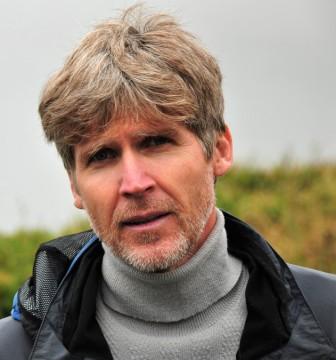
| Position: | associated professor |
| Room: | G-420 |
| Phone: | +421 2 9014 9270 |
| e-mail: | peter.uhlik@uniba.sk |
| Publications | list of publications |


Scientific interests
- Characterisation of industrial minerals – properties and use (bentonite, clays, diatomite, kaolin, magnesite, perlite, talc, zeolite and others)
- Clay minerals as indicator of geological processes (e.g. clay minerals as product of hydrothermal alterations – one of tools at the ore prospecting; clay minerals in sediments and soils as paleoenvironment indicator; clay minerals as paleotermometer)
- Bedrock and soil – a part of wine terroir
- Analytical methods of research: X-ray quantitative diffraction analysis; particle size distribution by XRD and HRTEM; iIllite crystallinity and expandability of mixed-layer illite-smectite as a paleothermometer)
Pedagogical activities
My teaching activities are mainly focused on the field industrial minerals and clay minerals, partly on economy of raw materials and mineral policy.
Bachelor’s degree:
- Raw Materials
- Deposits of industrial minerals
- Mineralogy and crystalochemistry of natural nanomaterials
- Applied mineralogy and Petrology
Master’s degree
- Industrial Minerals and Fossil Fuels of Slovakia and Neighbouring Areas
- World Deposits
- Field Course in Mineralogy, Economic and Environmental Geology
- Economy of raw materials
- Geomaterials
- Special Research Methods of Industrial Minerals
- Clays as indicator of geological processes
- Research Funding and Project Management
Doctoral degree
- Economic geology
- Mineralogical, Geochemical and Other Exploration Methods in Economic Geology
- Advanced Methods of Research in Economic Geology
The most significant publications
- Uhlík P., Šucha V., Eberl D. D., Puškelová Ľ. & Čaplovičová M., 2000: Evolution of pyrophyllite particle sizes during dry grinding. Clay Minerals, 35, 423-432.
- Uhlík P., Šucha V., Elsass F. & Čaplovičová M., 2000: HRTEM of mixed-layer clays dispersed in PVP-10: a new technique to distinguish detrital and authigenic illitic material.Clay Minerals, 35, 781-789.
- Honty M., Uhlík P., Šucha V., Čaplovičová M., Franců J., Clauer N. and Biroň A., 2004: Smectite-to-illite alteration in salt-bearing bentonites (The East Slovak basin).Clays and Clay Minerals, 52, 5, 533-551.
- Hooshiar, A ., Uhlík, P., Ivey, DG., Liu, Q ., Etsell, TH.,2012: Clay minerals in nonaqueous extraction of bitumen from Alberta oil sands Part 2. Characterization of clay minerals. FUEL PROCESSING TECHNOLOGY Volume: 96 Pages: 183-194.
- Bolanz, RM, Wierzbicka-Wieczorek, M., Čaplovičová, M., Uhlik, P., Gottlicher, J., Steininger, R; Majzlan, J., 2013: Structural Incorporation of As5+ into Hematite. ENVIRONMENTAL SCIENCE & TECHNOLOGY, Volume: 47, Issue: 16, 9140-9147.
The newest publications
- Lexa, J., Varga, P., Uhlík, P., Koděra, P., Biroň, A., Rajnoha, M.. 2021: Perlite deposits of the Central Slovakia Volcanic Field (Western Carpathians): Geology and properties. Geologica Carpathica, 2021, 72(3), pp. 253–281
- Pospíšilová, L., Uhlik, P., Menšík, L., Hlisnikovský, L., Eichmer, A., Horáková, E.(…); Vlček, V., 2020: Clay mineralogical composition and chemical properties of Haplic Luvisol developed on loess in the protected landscape area Litovelske Pomoravi. EUROPEAN JOURNAL OF SOIL SCIENCE 72 (3), pp.1128-1142
- Pálková Helena, Kureková Valéria, Madejová Jana, Netriová Zuzana, Uhlík, Peter, Varga Peter, Hronský Viktor, Lexa Jaroslav, 2020: Determination of water content in raw perlites combination of NIR spectroscopy and thermoanalytical methods. Spectrochimica Acta Part A: Molecular and Biomolecular Spectroscopy, 240, 15 October 2020, 118517
- Varga, P., Uhlík, P., Lexa, J., Šurka, J., Bizovská, V., Hudec P., Pálková, H., 2019: The influence of porosity on the release of water from perliteglass by thermal treatment. Monatshefte für Chemie, 150, 6, 1025-1040
- Osacký, M., Binčík, T., Paľo, T., Uhlík, P., Madejová, J., Czímerová, A., 2019: Mineralogical and physico-chemical properties of bentonites from the Jastraba Formation (Kremnicke vrchy Mts., Western Carpathians). Geologica Carpathica, 70, 5, 433-445.
- Andrezza de Almeida Azzia,, Peter Uhlík, Marek Osacký, Antenor Zanardo, Helena Palková, 2018: Changes in technological properties and microstructure of clayey raw materials from the Corumbataí Formation upon drying: Relevance to dry route tilemaking process. Applied Clay Science, 157, 92-101.
- Martin Pentrák, Viktor Hronský, Helena Pálková, Peter Uhlík, Peter Komadel, Jana Madejová, 2018: Alteration of fine fraction of bentonite from Kopernica (Slovakia) under acid treatment: A combined XRD, FTIR, MAS NMR and AES study. Applied Clay Science, 163, 204-213.
- Koděra, P., Kozák, J. Brčeková, J., Chovan, M., Lexa, J. Jánošík, M., Biroň, A., Uhlík, P., Bakoš, F.: 2018: Distribution and composition of gold in porphyry gold systems: example from the Biely Vrch deposit, Slovakia. Mineralium Deposita, 53, 8, 1193-1212.
- Vlček, V., Pospíšilová, L., Uhlík, P., 2018: Mineralogy and chemical composition of cryosols and andosols in Antarctica. Air, Soil and Water Research, 13, 2, 61-73
Current Projects
APVV-20-0175 – principal investigator of the project (2025-2029) „Advanced applications of clay raw materials and perlite in the field of building materials” Click for project annotation